
Blanchard Springs Caverns’ Early Story Lives on in Lyon College Archives
BATESVILLE, Arkansas –As state leaders move toward designating Blanchard Springs Caverns as Arkansas’s 53rd state park, a quieter but equally significant chapter of the caverns’ history rests in a climate-controlled room inside Lyon College’s Mabee-Simpson Library in Batesville.
 Years before the state of Arkansas took steps to elevate Blanchard Springs Caverns toward state park status through a new memorandum of understanding with the U.S. Forest Service, two local explorers were crawling through the darkness armed with curiosity, carbide lamps and hand-drawn maps.
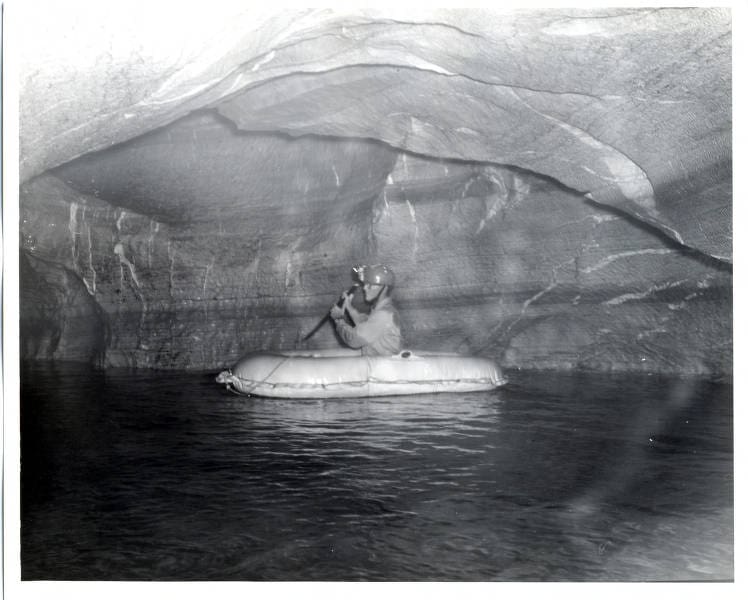
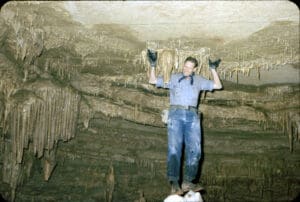
One of them, Batesville native Hail Bryant, would become a pioneer of northern Arkansas spelunking. With his exploration partner Hugh Shell, Bryant spent the 1950s and 1960s charting the hidden caves that honeycomb the Ozarks. Their work led the first professional expedition to explore and map the caverns that later became known as Blanchard Springs Caverns, now one of the state’s most visited natural wonders.
Bryant, who died in 2011 at age 83, was not only a trailblazer in caving but also a lifelong community leader. Born in Huff (Independence County) in 1927, he attended Batesville High School and studied at both Lyon College (then Arkansas College) and the University of Arkansas. A draftsman and business leader, he produced the blueprints for many homes built in the area, including the first all-electric home built in Arkansas.
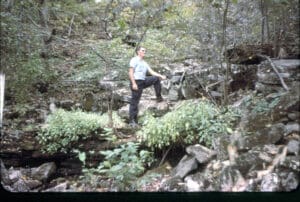
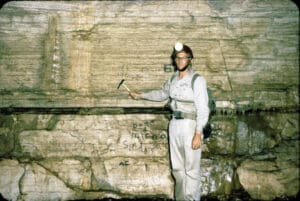 He co-owned Bryant Lumber Company and helped develop numerous subdivisions around Batesville. An avid outdoorsman and amateur geologist, he explored hundreds of caves, collected Native American artifacts, fossils and geological specimens, and taught hunter safety for more than three decades.
Beginning in 1959, Bryant, his wife Faye, Shell and others began exploring Blanchard Springs Caverns, then known as One-Half Mile Cave. Their mapping, photographing and careful documentation convinced the U.S. Forest Service to develop it as a tourist attraction.
Today, the Mabee-Simpson Library preserves Bryant’s legacy in the Hail Bryant Collection, a trove of photographs, slides, maps, newspaper clippings and videotaped interviews documenting decades of cave discovery. The collection also includes cave inspection reports and Bryant and Shell’s hand-drawn map of Half-Mile Cave. Nancy S. Griffith, retired archives and special collections librarian at Lyon College, completed processing the collection in 1992. Kim Halpain and Judy Blackwell finalized detailed indexing and the website finding aid in 2002.
For some, the history preserved in the archives is also deeply personal.
“Growing up in Batesville, we lived next door to Faye, Hail and their son, Dale, for several years,” said Skip Rutherford of Little Rock, a member of the Lyon College Board of Trustees. “I remember hearing Hail tell stories about how magnificent these caverns were. I am grateful that Lyon College has preserved and documented his historic collection.”
 The reach of Bryant’s work extended well beyond exploration and into scientific understanding, preservation and even Cold War-era civil defense planning.
“The cave inspection reports produced by Hail Bryant, Hugh Shell and their compatriots were an especially useful resource in my own cave research,” said Dr. David Thomas, W.D. Bryan Professor of Biology and adviser for Cavers Of the Batesville Region of Arkansas Grotto (COBRA Grotto) at Lyon College. “The group surveyed approximately 200 caves and mines in Arkansas to find out how many would be useful as fallout shelters. Keep in mind that this was right around the same time as the Cuban missile crisis.”
“Fortunately, nuclear war did not happen, and most caves would have been poor shelters,” Dr. Thomas said. “What did result was a much deeper understanding of caves in the region. I spent my 2010 sabbatical compiling and mapping those reports and preserving them in digital form.” Thomas’s digitized copies of Bryant and Shell’s cave inspection files are housed on CD in the Mabee-Simpson Library at Lyon.
That spirit of research and education continues today through Dr. Thomas and COBRA Grotto, an official chapter of the National Speleological Society that engages in scientific, recreational and educational caving throughout the Ozarks. The group meets at 7 p.m. on the first Wednesday of each month during the school year in Room 16 of the Derby Center for Science and Mathematics at Lyon College. Meetings are open to the public.
As Arkansas moves toward formally establishing Blanchard Springs State Park, the Mabee-Simpson Library’s archives serve as a reminder that the caverns’ future is rooted in the curiosity and persistence of explorers who mapped its depths long before it became a tourist destination.
The Hail Bryant Collection is open to researchers, students and the public. The full collection can be accessed online athttps://lyon.contentdm.oclc.org/digital/collection/p16642coll2/search, and the primary box of original materials is available for in-person study by appointment.
Researchers may request access to the physical collection by contacting Kassandra Meyer, resource sharing librarian, at Kassandra.Meyer1@Lyon.edu to schedule an appointment.
Thomas’s digitized copies of Bryant and Shell’s cave inspection files are also housed on CD in the library at Lyon College.
Lyon College also maintains an extensive collection of geological resources on the third floor of the Derby Center for Science and Mathematics, which is open from 8 a.m. to 5 p.m. Monday through Friday.