
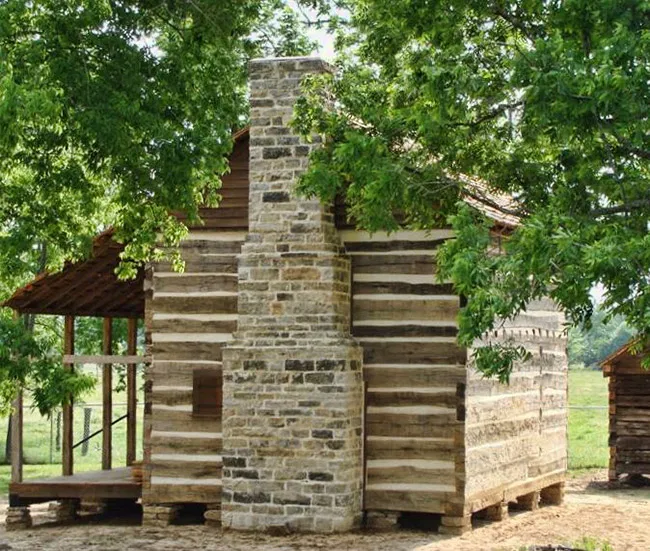
For travelers seeking an authentic glimpse into Arkansas history, the Rice-Upshaw House in northwestern Randolph County is a must-visit destination. Nestled in the Eleven Point River Valley near the small community of Dalton, this historic site stands as one of the oldest surviving rural trading centers in the state. Locally known as Reuben Rice’s, the house and its surrounding structures provide a fascinating window into 19th-century pioneer life in the Ozarks.
A Pioneer’s Vision: Reuben Rice and the Early Trading Center
The story of the Rice-Upshaw House begins in 1812, when Reuben Rice traveled in the valley by wagon train, joining a network of settlers from Hawkins County, Tennessee. By 1828, Rice had constructed the log cabin that would serve as both a store and loom house, supporting a small rural trading center. Here, Rice sold goods produced on his farm, including linen and other fabrics, while trading locally grown corn and wheat. The center also functioned as a community gathering place, hosting elections and providing a base for road-building in the early days of Randolph County.
Standing near the main cabin, visitors can also see a granary from the 1820s and a log smokehouse from the 1840s, both integral to the farmstead and daily frontier life. These structures are not only among the oldest of their kind in Arkansas, but together they represent the state’s only surviving example of a rural trading center, offering a tangible connection to the region’s settlement history.
Architecture and Daily Life on the Frontier
The original first-floor room of the Rice-Upshaw House features a gable-end fireplace, while an adjoining side-room with original shelving was likely used to store merchandise for the trading center. This rare architectural feature provides insight into early American vernacular design and the practical needs of a frontier store. Visitors can imagine the bustling daily life of the Rice family: weaving linen on the loom, trading goods with neighbors, and managing the farm and trading center.
In the 1840s, Reuben Rice’s youngest son, Thomas Blackman Rice, expanded the home by adding an upper half-story and a stone chimney with two fireboxes, converting the original shop into a comfortable family residence. Over the years, the house saw continuous occupancy by the Rice and Upshaw families, preserving a remarkable record of frontier life and architectural adaptation.
Preservation and Education: Project REACH
The Rice-Upshaw House was listed on the National Register of Historic Places in 2004. That same year, the James Upshaw family donated the house, granary, smokehouse, and historical artifacts—including the original loom brought by Reuben Rice on the 1812 wagon train—to Black River Technical College in Pocahontas.
From 2006 to 2011, the college conducted a comprehensive multi-disciplinary restoration funded by the Arkansas Natural and Cultural Resources Council. Today, the site operates as a museum and educational center, connecting visitors to settlement-period architecture, early Arkansas culture, and the history of rural trading centers. Through Project REACH (Researching Early Arkansas Cultural Heritage), the Rice-Upshaw House uses multimedia presentations and exhibits to explain the restoration process, archaeological findings, and historical context, making it a rich resource for students, historians, and travelers alike.
Visiting the Rice-Upshaw House
Visitors to the Rice-Upshaw House can explore the hand-hewn logs, granary, smokehouse, and surrounding acreage, gaining a vivid understanding of life in the early 1800s. Guided tours and educational programs highlight the craftsmanship, ingenuity, and community spirit of Arkansas pioneers. Photographers and history enthusiasts alike will find the well-preserved log structures and scenic Eleven Point River Valley landscapes perfect for capturing the essence of frontier Arkansas.
The Rice-Upshaw site also offers opportunities for families to experience history hands-on, making it a valuable destination for travelers of all ages. Whether you are drawn by architecture, local history, or cultural heritage, the house and its grounds provide a memorable and educational experience.
Why the Rice-Upshaw House Matters
The Rice-Upshaw House is more than just a historic building; it is a living testament to the resourcefulness, vision, and perseverance of early Arkansas settlers. From its origins as a trading center to its transformation into a family home, and finally to its careful restoration and preservation, the site tells the story of community-building, frontier life, and the evolution of rural Arkansas.
For anyone planning a visit to northeastern Arkansas, the Rice-Upshaw House offers a unique chance to step back nearly 200 years, explore pioneer craftsmanship, and experience the heritage of the Ozarks in a way few other sites can offer.