In the quiet and small community of Cushman, few could have imagined that one of their own would go on to build a fast-food empire that would stretch across the country. But that is exactly what Harmon Dobson did—turning small-town ambition into a bold, bigger-than-life brand known as Whataburger.
Harmon was the oldest of four children in a family deeply rooted in Cushman. The Dobsons were known as one of the area’s oldest families and were deeply involved in the local Methodist church. In fact, his grandmother served as Sunday school superintendent until her passing, and throughout his life, Harmon continued to send money back home to support the church. That strong foundation of faith, family, and community would remain with him no matter how far he traveled.
Dobson actually left Cushman well before 1930 in search of opportunity and adventure. Like many during that era, he returned home during the hardships of the Great Depression, but it was only a temporary stop. Determined to build something more, he left again—this time heading to New York, where he learned shipbuilding. That skill would prove valuable during World War II, when he worked overseas building for the government.
His work took him around the world, exposing him to experiences far beyond rural Arkansas. He traveled to places like the pyramids of Egypt and even ventured into the Amazon to look for diamonds, and even came back with some beautiful treasures. These experiences gave him a broader perspective and helped shape the bold thinking that would later define his business success.
Before entering the restaurant industry, Dobson explored other ventures, including working as a used car dealer. Even then, his entrepreneurial mindset was clear—he was always looking for ways to do things better. He didn’t marry until March 11, 1955, when he wed Grace, who would later play a key role in continuing his legacy.
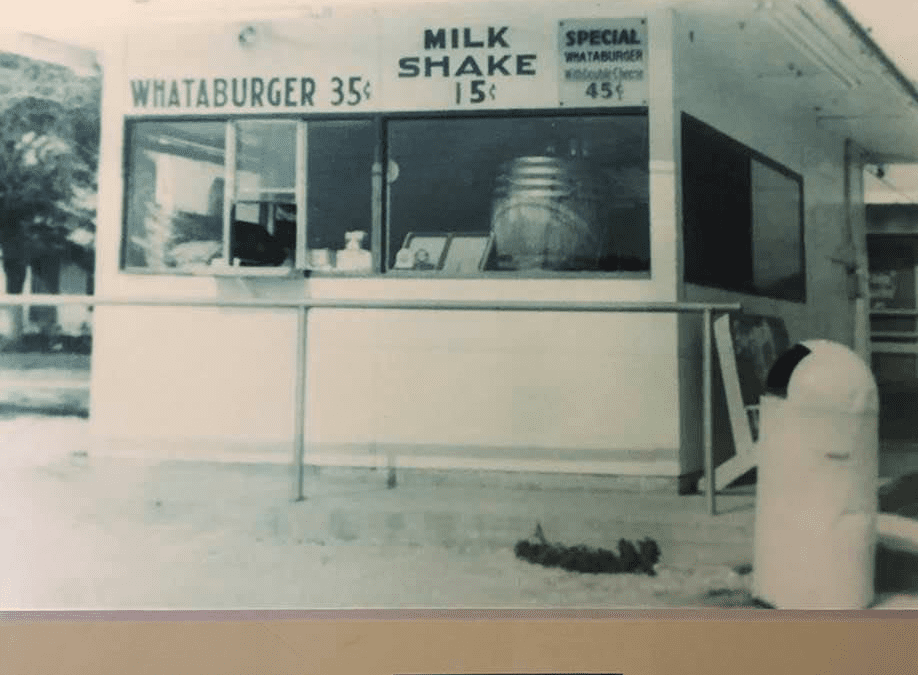
Dobson’s breakthrough idea was simple but revolutionary: create a bigger, better-quality hamburger than anyone else. At a time when most burgers were small and inexpensive, he set out to offer something more satisfying. To make his vision a reality, he had to secure a special machine to produce larger buns that could match his oversized patties. He priced his burger at 25 cents—higher than competitors—but customers quickly embraced the quality and value. Leaning into the idea that everything is bigger and better in Texas, his marketing helped define what would become a legendary brand.
That vision became reality on August 8, 1950, when Dobson and partner Paul Burton opened the very first Whataburger in Corpus Christi. From that single stand, the brand began to grow rapidly. By 1953, Whataburger had its first franchise, and by 1959, it expanded beyond Texas into Florida. In 1961, the now-iconic A-frame restaurant design was introduced, followed by menu additions like fries and fried pies in 1962.
By 1963, Whataburger had expanded to 26 locations across multiple states, a remarkable achievement in just over a decade. Dobson’s drive to grow and innovate helped shape the company into a regional powerhouse. Tragically, his life was cut short on April 11, 1967, in a plane crash.
After his passing, his wife Grace chose not to sell the business. Instead, she took over leadership and continued to expand Whataburger, becoming chairman of the board in 1969. Under her direction, the company introduced major innovations, including its first drive-thru in 1971, its 100th location in 1972, and new menu items like the Whataburger Jr., onion rings, and jalapeños in 1973. That same year, the iconic “Flying W” logo was adopted.
The company continued to grow steadily over the decades, reaching 300 locations by 1980, 400 by 1987, and 500 by 1995. It evolved with the times, adding breakfast menus, operating 24/7, expanding into new states, and eventually embracing digital ordering and modern innovations. By 2024, Whataburger opened its 1,000th location, and in 2025, it celebrated its 75th anniversary—an incredible milestone for a company that began with one man’s vision.
Despite his success, Dobson never forgot his roots. His funeral was held at the Cushman Methodist Church, and he was laid to rest in Batesville alongside his parents and siblings. His grandparents are buried at Pleasant Valley Cemetery in Cushman. He also made a point to include family in his business whenever possible. One nephew, who still lives in Mount Pleasant in his late 80s, even worked for Whataburger one summer before choosing a successful life in farming.
Harmon Dobson’s life is a remarkable story of ambition, resilience, and vision. From a small Arkansas town to global travels, and the creation of a fast-food icon, his journey feels larger than life. Yet at its heart, it remains a story of a man who never forgot where he came from—and who proved that even the biggest dreams can begin in a small town like Cushman.